Artno
The artist Assemblages Paintings Photography Contact
PT FR EN

Assemblages

Driftwood, plastics and sand speak here while keeping their memory intact.

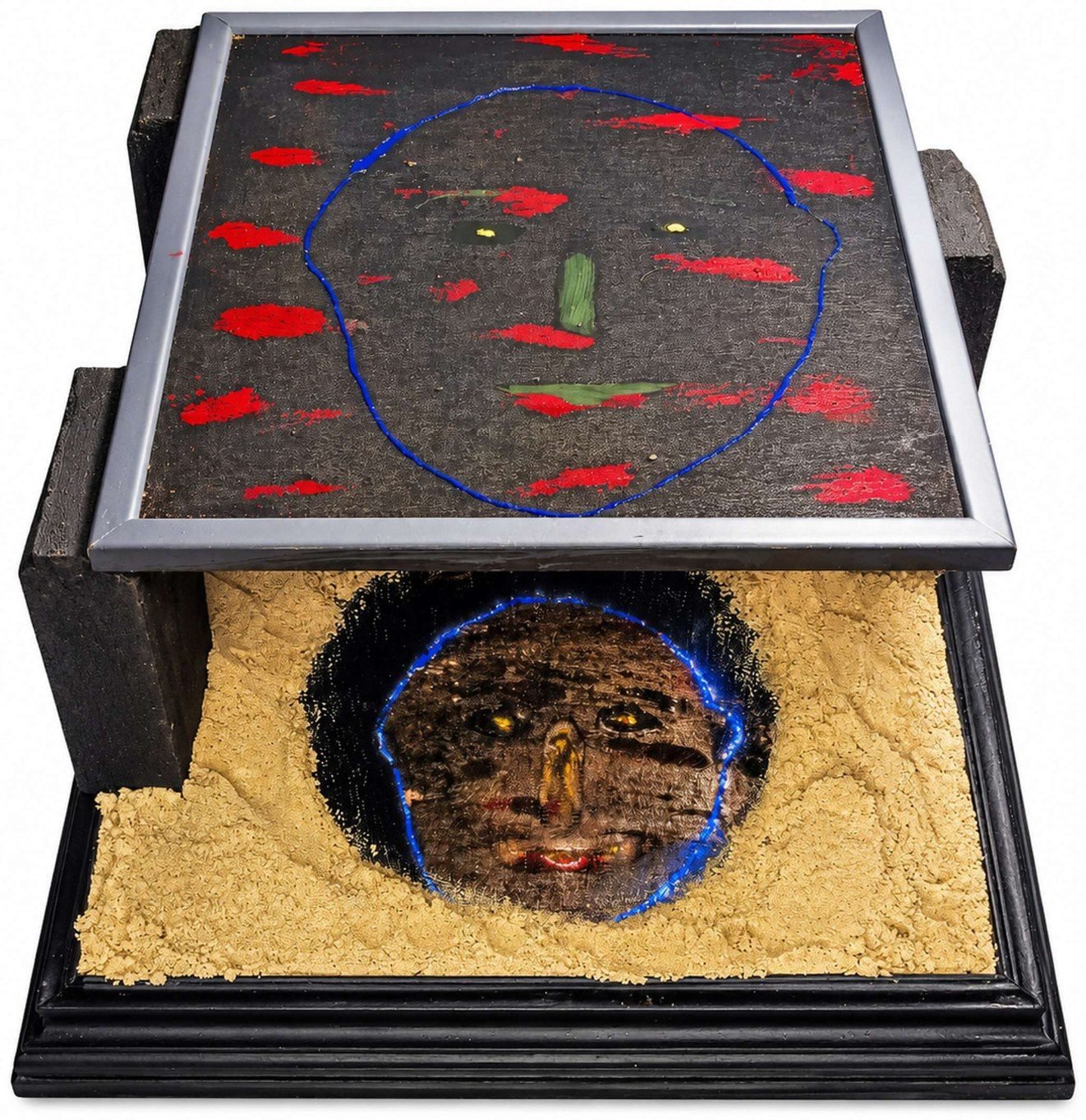
Self-Portrait — Glass pane, mirror, sand, oil paint — Arnaud Caron (Artno)

Self-Portrait

The portrait is reflected in the mirror
MaterialsGlass pane, mirror, sand, oil paint
Dimensions40 × 30 × 40 cm

The artist is not seeking physical likeness: he builds his identity through matter, colour and assemblage. The face becomes less the representation of an individual than that of an inner state. The overlapping of the two faces can evoke the different layers of identity: the face we show and the one we hide, appearance and interiority, the conscious and the unconscious.

The work does not try to answer the question ‘What do I look like?’ but a deeper one: ‘What lies behind the image I give of myself?’ It presents identity as a complex construction, made of successive layers, contradictions, wounds and memory. Knowing oneself requires digging into the matter.
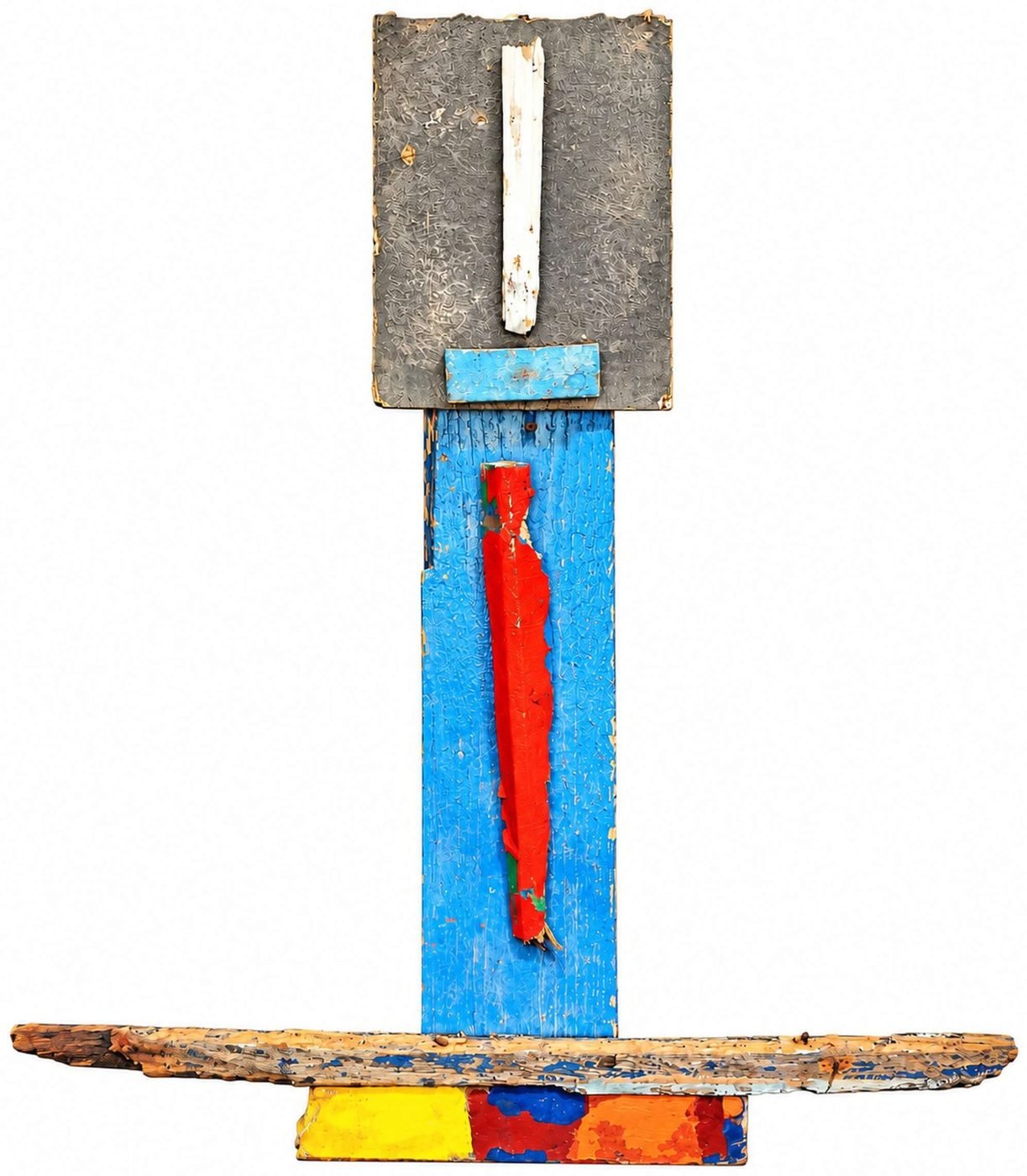
Anophthalmia — Wood — Arnaud Caron (Artno)

Anophthalmia

MaterialsWood
Dimensions60 × 40 cm
TypeMobile

The work is built around the absence of a gaze, immediately steering the reading of this assemblage toward perception, blindness and, more broadly, our capacity — or our refusal — to see. The blind figure also embodies a society that keeps moving forward while remaining unable to look certain realities in the eye.

Paradoxically, by removing the figure’s eyes, the work calls even more on those of the viewer. Absence becomes an invitation to look differently.

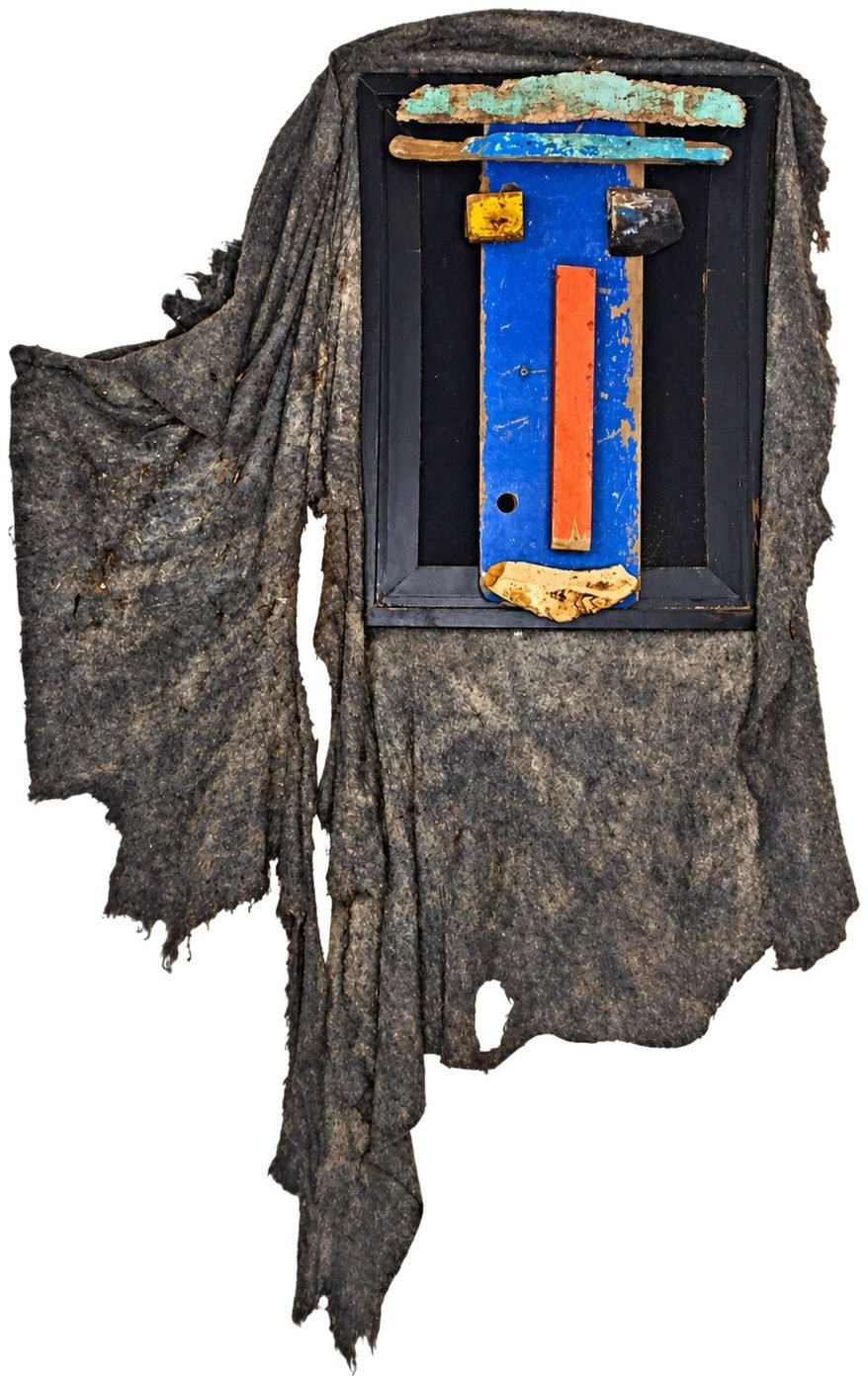
Shroud — Wood, fabric, acrylic paint and sand mixed together — Arnaud Caron (Artno)

Shroud

MaterialsWood, fabric, acrylic paint and sand mixed together
Dimensions80 × 65 cm

‘Shroud’ appears as an almost totemic figure whose fabric covers the body while leaving the face visible, like a last trace of identity in the face of disappearance. It no longer necessarily depicts an individual, but a symbolic representation of humankind confronted with its own finitude.

The work can thus be read as a reflection on death, but also on what remains after it. The body disappears, matter decays, yet something of the being still resists erasure.

War and Peace — Wood — Arnaud Caron (Artno)

War and Peace

MaterialsWood
Dimensions180 × 80 cm

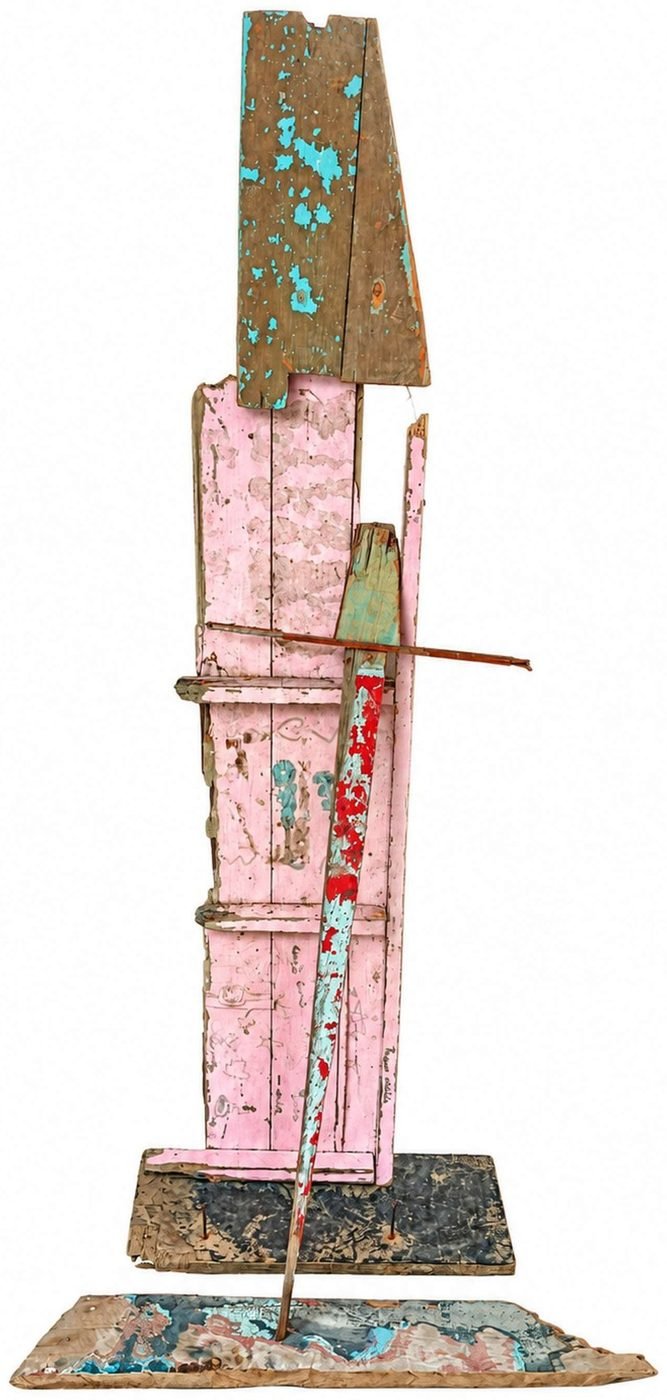
Despite the wounds of time, the work still stands upright, evoking a humanity crossed by opposing forces. Unstable, it affirms that peace is never definitively secured and remains constantly under threat. It becomes a metaphor for humanity: fragile, wounded by its own history, yet able to remain standing and to keep believing in peace.

To rebuild does not mean erasing the traces of the past, but managing to create a new balance out of what has been broken.

Neither God Nor Master — Wood, spray paint — Arnaud Caron (Artno)

Neither God Nor Master

MaterialsWood, spray paint
Dimensions200 × 400 cm

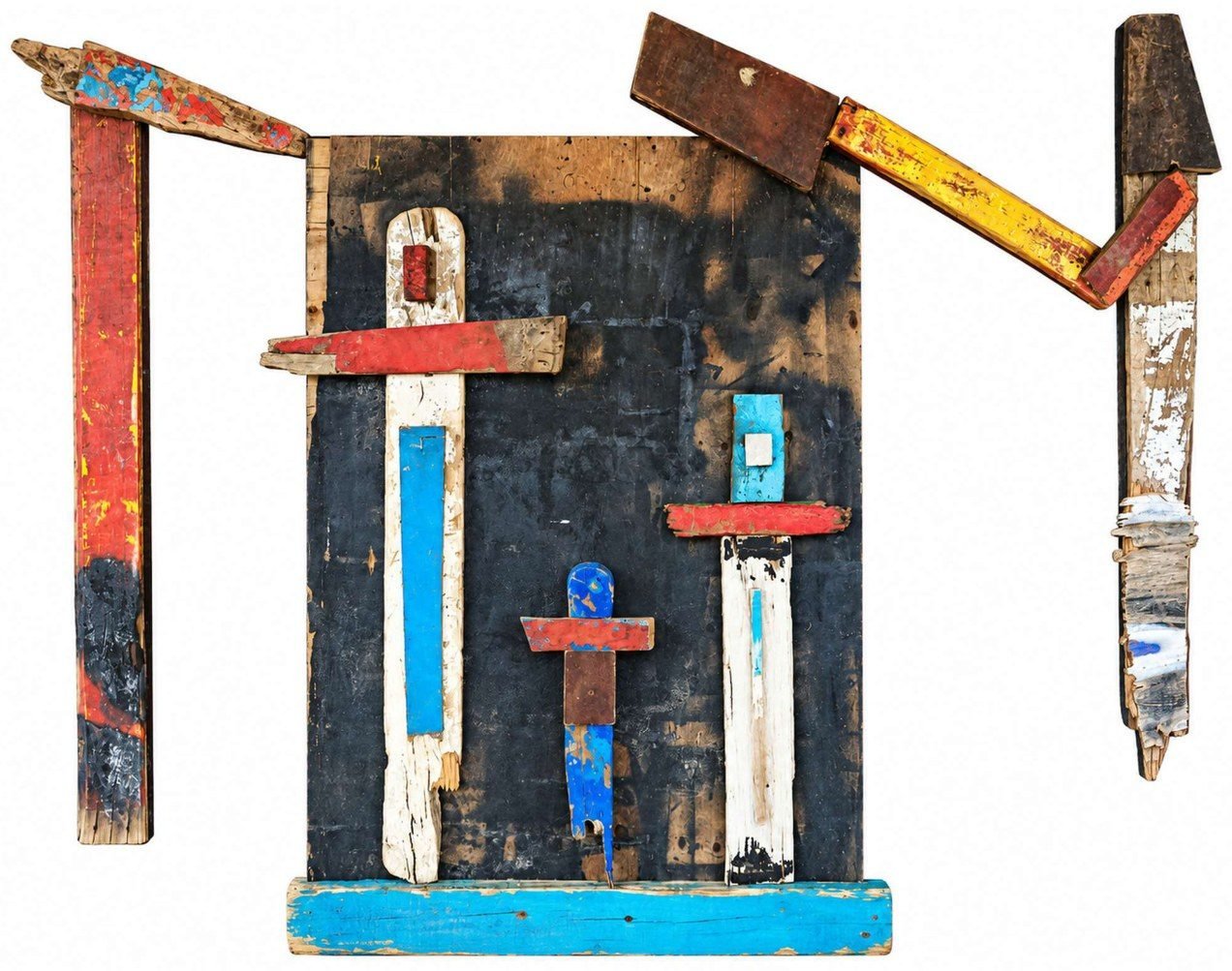
The human figures are confronted with structures that seek to frame, direct or dominate them. The work invites a reflection on the refusal of any absolute authority, whether spiritual, political or social.

It does not merely represent revolt: above all, it evokes the will to build one’s own existence outside imposed frameworks. To be free then means stepping outside the frame, refusing established hierarchies, and becoming one’s own master.

The Fishermen — Wood, thread — Arnaud Caron (Artno)

The Fishermen

MaterialsWood, thread
Dimensions120 × 80 cm
TypeMobile

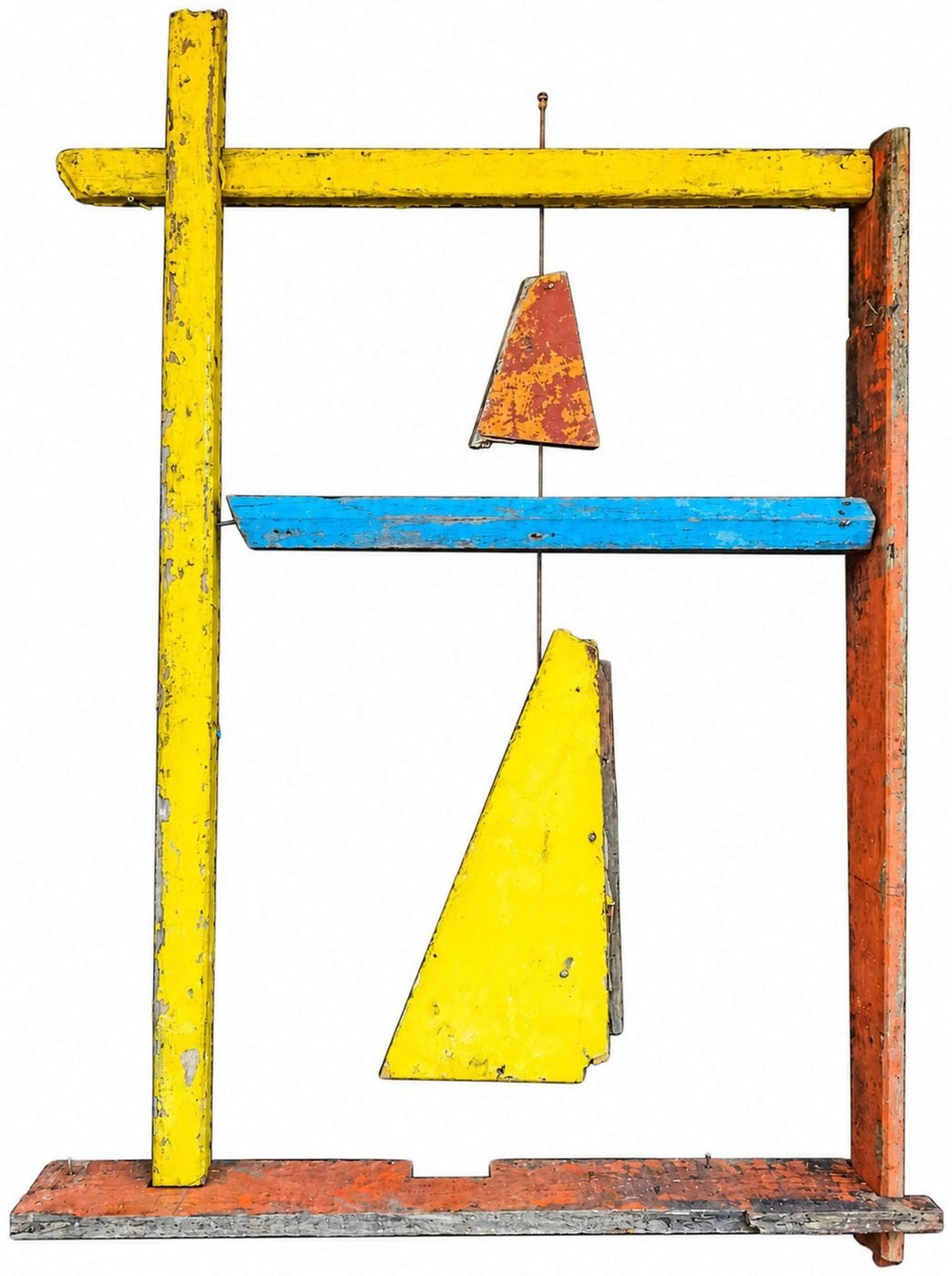
‘The Fishermen’ evokes the maritime world. The suspended geometric shapes represent the sails of boats. Conceived as a mobile, the work sets them in motion in the wind, evoking boats under sail. The wood used comes from old fishing boats. It is therefore not simple reclaimed material: it carries within it the memory of the sea and of the fishermen who once used it. Transformed, these fragments symbolically continue their voyage.

The work thus establishes a dialogue between memory and movement. Carried once again by the wind, the old vessels symbolically return to the sea and keep sailing in another form.

Sun Thief — Wood, plastics, fishing line, acrylic paint and sand mixed together — Arnaud Caron (Artno)

Sun Thief

MaterialsWood, plastics, fishing line, acrylic paint and sand mixed together
Dimensions95 × 75 cm

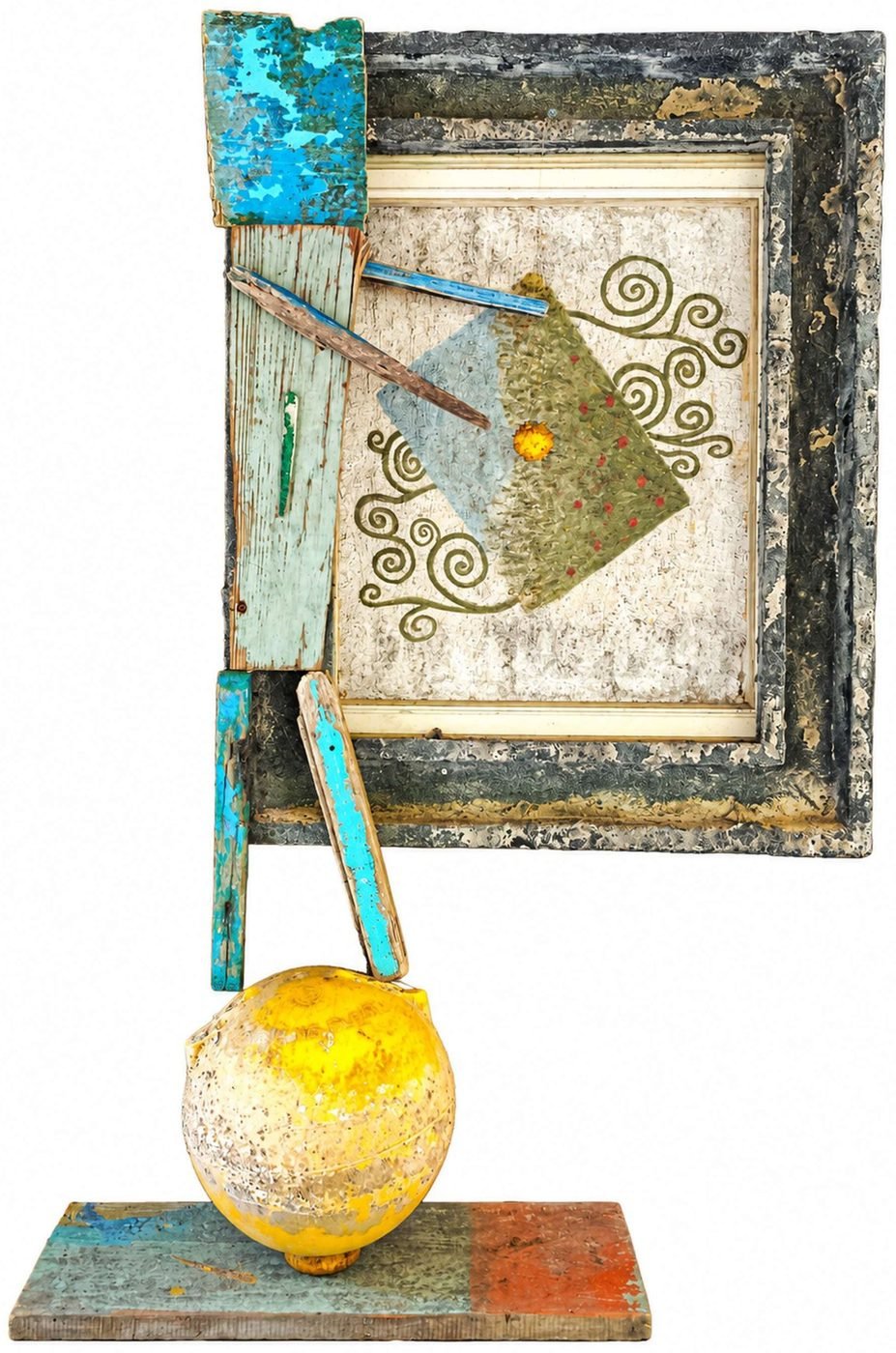
The character does not try to steal the sun in its entirety: he takes a part of it and makes it his own. The sun then becomes the symbol of a natural wealth that mankind treats as available, exploitable and divisible, even though it is essential to our existence.

A paradox appears: the thief rests precisely on what he strips away. His balance and his survival depend on this very source, which he progressively fragments to satisfy his desire for possession.

The work thus becomes a metaphor for our contradictory relationship with the earth: we draw from what keeps us alive, at the risk of gradually destroying what sustains us.

Archangel — Wood, vine, stone — Arnaud Caron (Artno)

Archangel

MaterialsWood, vine, stone
Dimensions180 × 50 cm

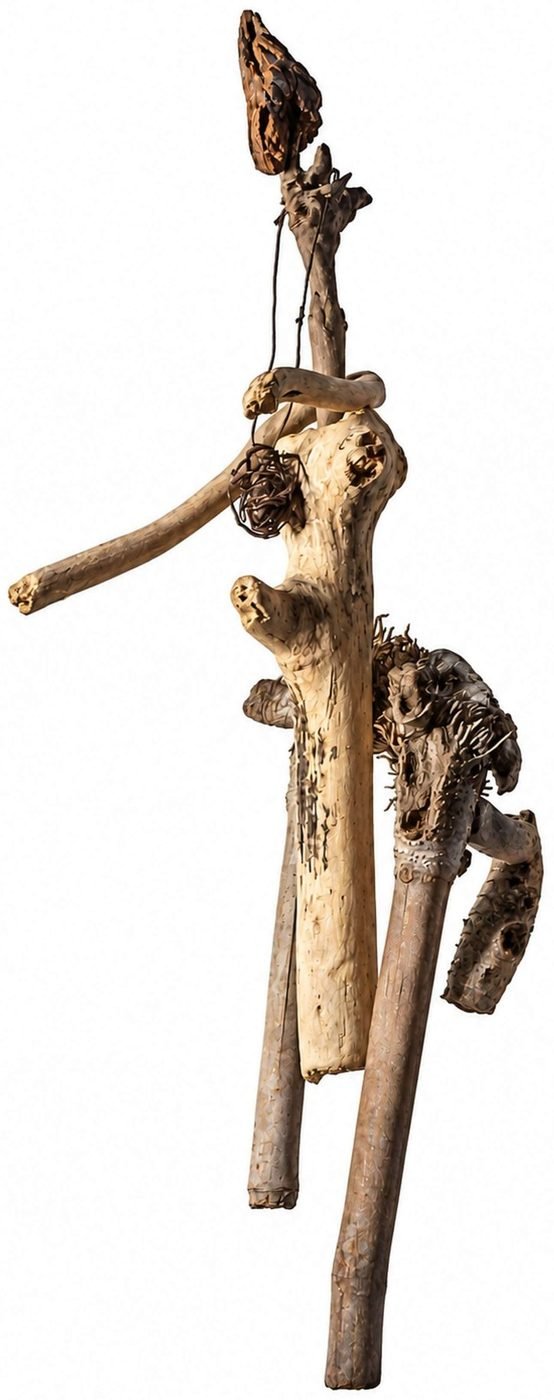
The work thus plays on a paradox: bringing a spiritual figure to life out of humble, weathered, perishable matter. The sacred no longer comes from perfection, but from transformation. What seemed fragmentary or abandoned gains a new existence through assemblage.

‘Archangel’ can then be seen as a figure of resilience and protection: a vulnerable guardian, shaped by the wounds it carries. The work suggests that strength does not necessarily lie in the absence of fragility, but in the capacity to remain standing in spite of it.

Dark Night of the Soul — Plastic, polyester, acrylic paint and sand mixed together — Arnaud Caron (Artno)

Dark Night of the Soul

MaterialsPlastic, polyester, acrylic paint and sand mixed together
Dimensions65 × 80 cm

At the heart of darkness, something still remains: an emotion, a consciousness, a possibility of rebirth. It is the mirror of the human soul as it passes through its darkest periods before union with the divine.

Revealing a profound inner crisis, a feeling of emptiness or desolation, this experience cuts the individual off from all meaning and acts as a passage toward transformation or awakening.

Nyx — Plastics, polystyrene, acrylic paint and sand mixed together — Arnaud Caron (Artno)

Nyx

MaterialsPlastics, polystyrene, acrylic paint and sand mixed together
Dimensions80 × 65 cm

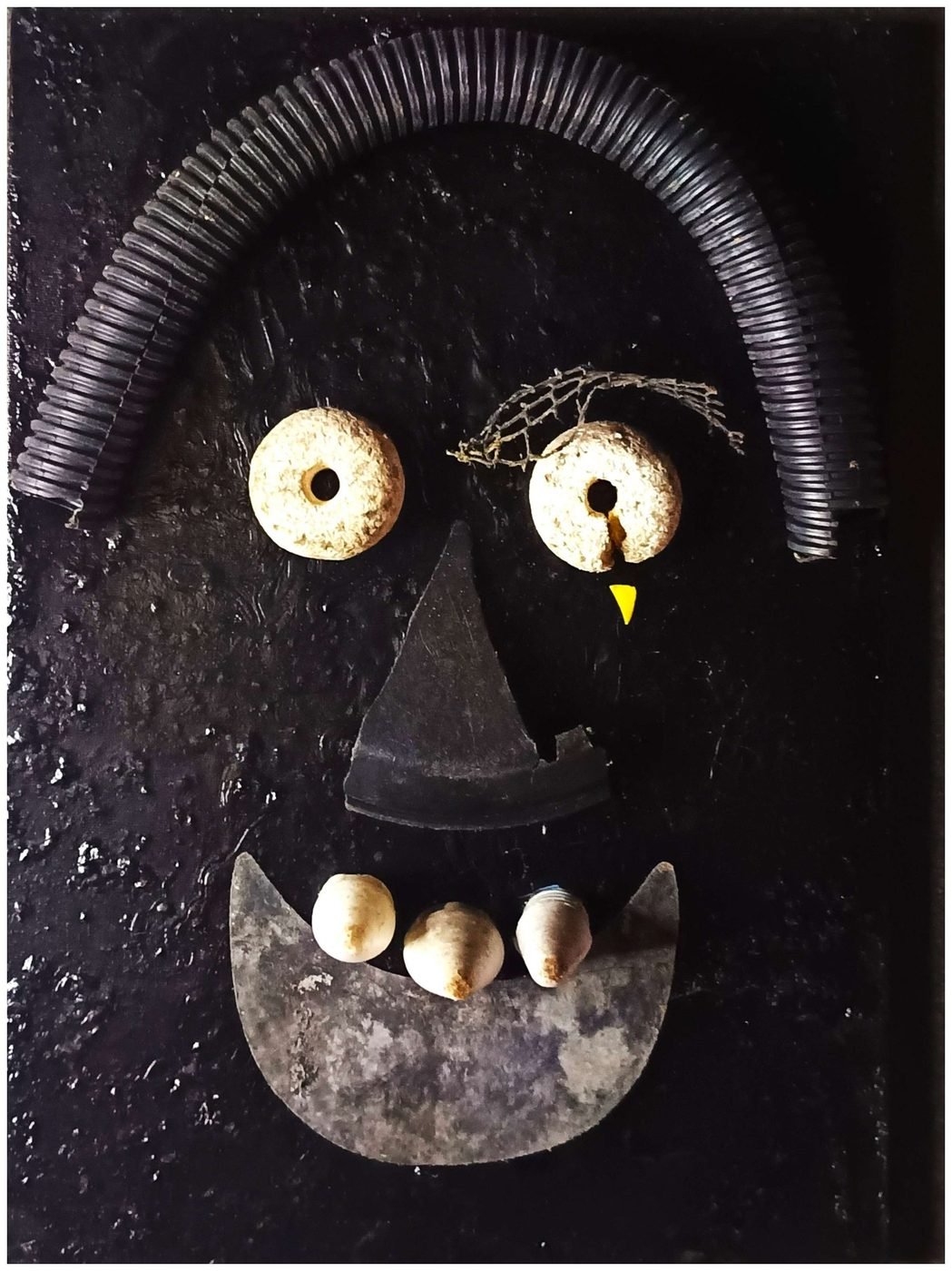
The title refers to the goddess of Night in Greek mythology, born of primordial Chaos, immediately giving this figure a dark, mysterious and almost sacred dimension. The whole possesses an almost totemic force: that of a primitive mask recomposed from the discards of modernity, where the sacred and the discarded merge.

By giving Nyx a face, the work does not seek to literally depict the goddess of Night. It instead offers a contemporary incarnation, fragile and imperfect, made of abandoned fragments. Night then becomes a territory where what has been rejected regains a presence and an identity.

Self-Destruction — Plastics, polystyrene, sand, acrylic paint — Arnaud Caron (Artno)

Self-Destruction

MaterialsPlastics, polystyrene, sand, acrylic paint
Dimensions80 × 65 cm

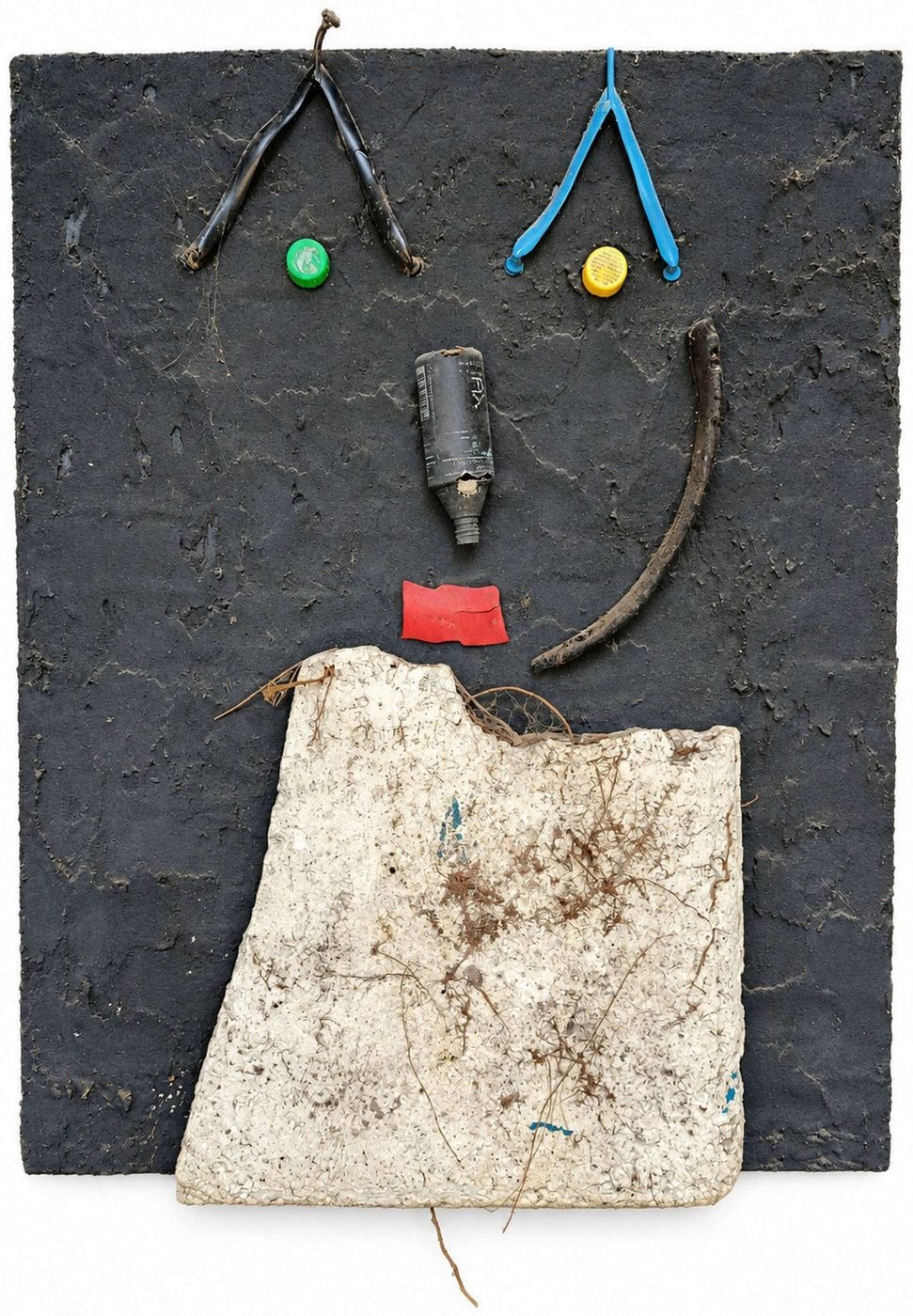
‘Self-Destruction’ depicts a human face in the act of drinking, made entirely of waste and fragments of discarded material. The bottle raised to the mouth turns a vital, everyday gesture into a disturbing image: the man appears to absorb what he himself produced and threw away.

By polluting his environment, the human being ends up symbolically ingesting his own pollution. What he discards in nature comes back to him, notably through water and the food chain. Waste is then no longer external to mankind: it enters the body and becomes part of the self.

The work thus places humanity before a paradox: by contaminating what allows it to live, it becomes the very architect of its own destruction.

Prisoner — Fabric, fishing line — Arnaud Caron (Artno)

Prisoner

MaterialsFabric, fishing line
Dimensions50 × 50 × 120 cm
TypeMobile

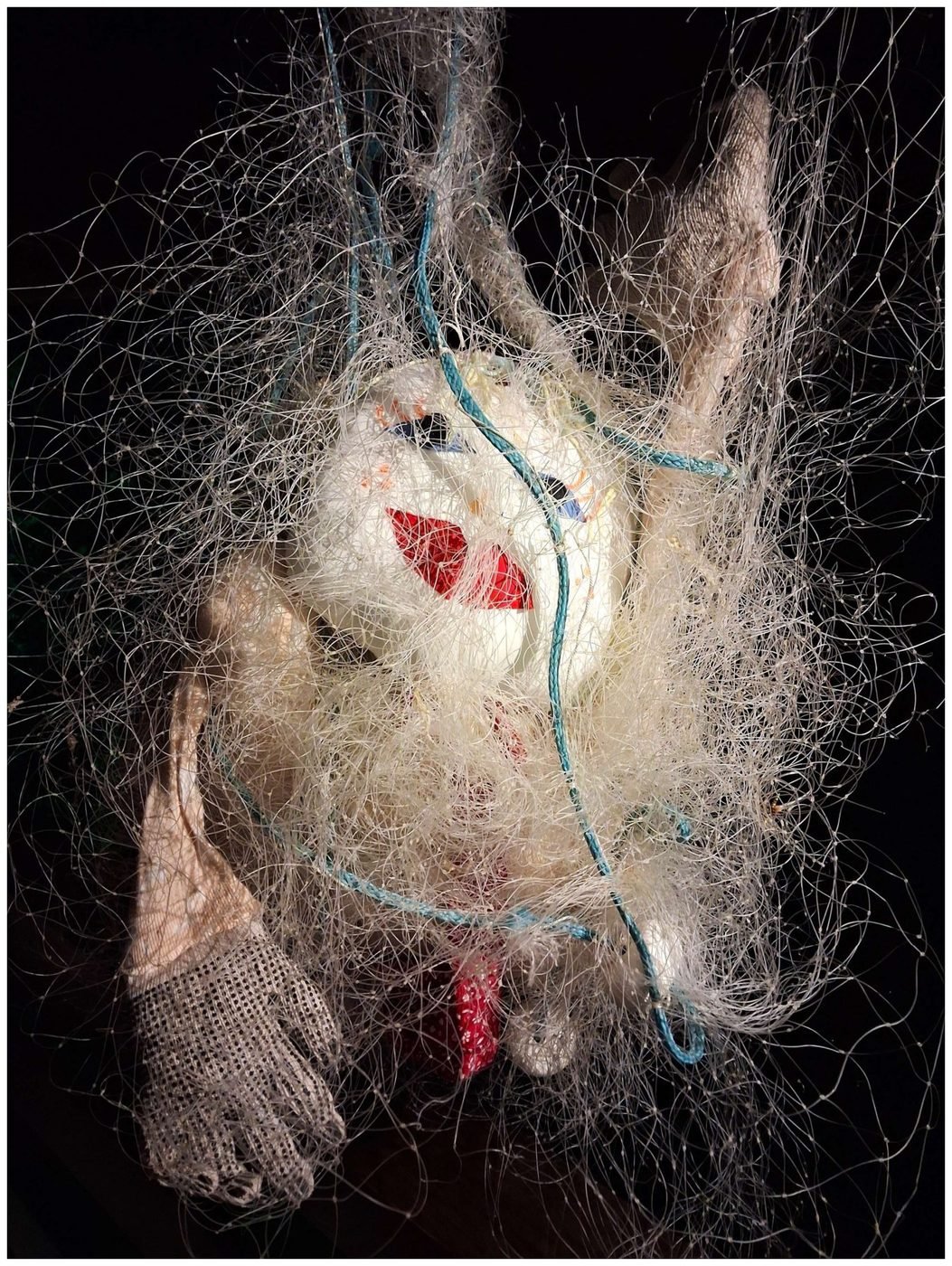
The work stages an organic form caught in a tangle of nets, cordage and plastic materials. At once fragile and unsettling, this figure seems to gradually disappear beneath the materials that imprison it.

The threads invade the space until the boundary between the living and the discarded becomes uncertain. What was meant to catch and to serve mankind here becomes a trap closing in on life itself.

The work can thus be understood as a metaphor for our relationship with the environment: the objects we produce to master the world end up invading it and imprisoning the living.

Modern Man — Plastics, polystyrene — Arnaud Caron (Artno)

Modern Man

MaterialsPlastics, polystyrene
Dimensions120 × 80 cm

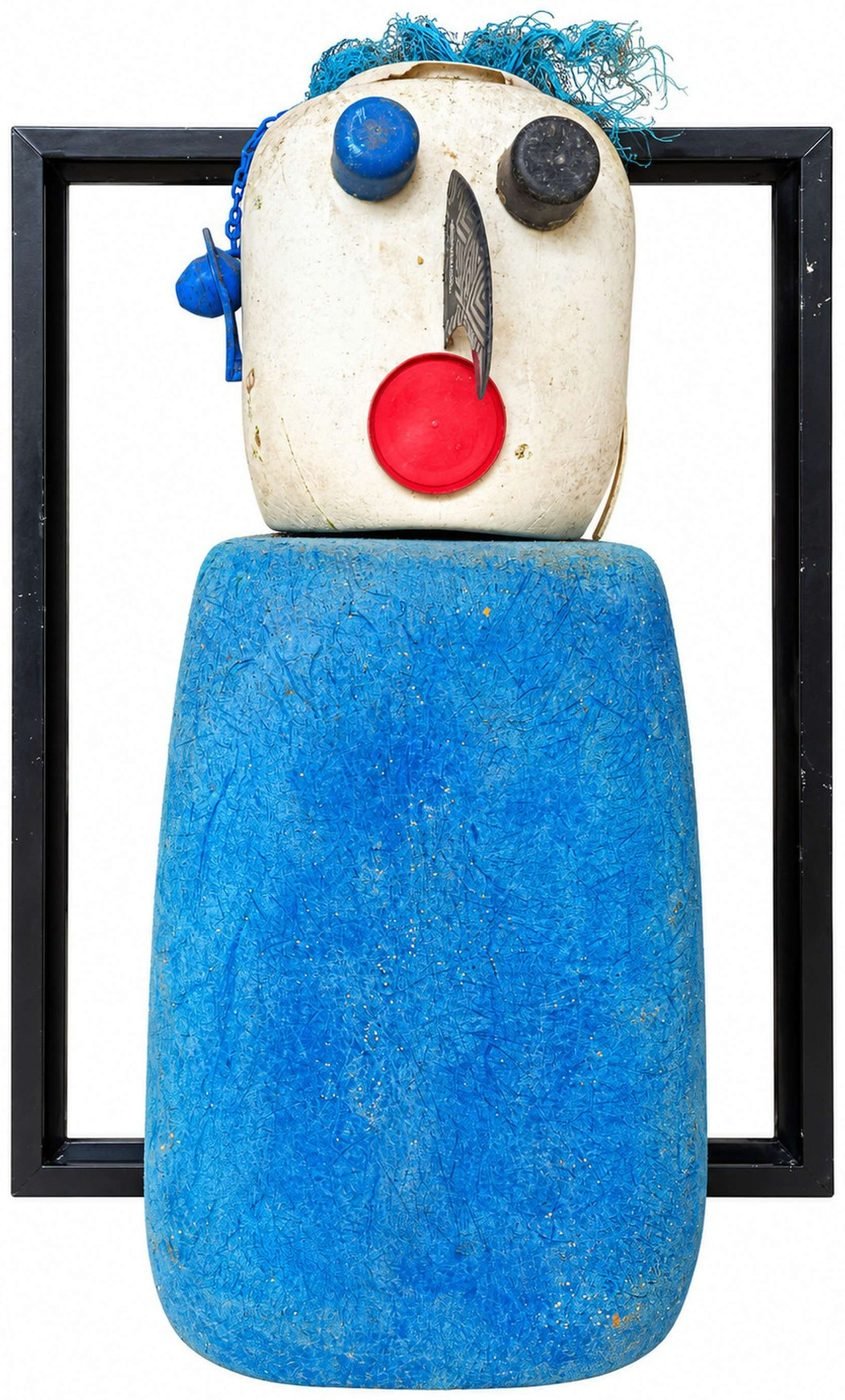
The hybrid figure, half human, half object, directly questions the condition of contemporary man. Its appearance — at once primitive, mechanical and almost robotic — creates a paradox: modern man, despite his technological progress, here seems recomposed from the remnants of his own civilisation.

The repurposed objects lose their original function to form a new body, as if the individual ended up merging with what he manufactures, consumes and discards.

At once playful and unsettling, the work ultimately raises a question about our identity: what remains of man when the objects he creates, uses and abandons end up becoming his own portrait?

Third Eye — Plastics — Arnaud Caron (Artno)

Third Eye

MaterialsPlastics
Dimensions22 × 32 cm

In many spiritual traditions, the third eye refers to an inner perception. It is an invitation to look with intuition and clairvoyance in order to access another understanding of reality.

The third eye then becomes that of the artist: a gaze capable of revealing another reality that the everyday eye no longer notices.

Umbilical — Plastics, sand — Arnaud Caron (Artno)

Umbilical

MaterialsPlastics, sand
Dimensions100 × 140 cm

‘Umbilical’ questions our relationship of dependence on the artificial systems we have created. Contemporary humans seem connected to machines by a vital link, like a child to its mother: what was originally meant to serve us gradually becomes what we can no longer detach ourselves from.

The work thus maintains a tension between autonomy and dependence, between birth and confinement. An essential question then arises: are we still masters of our machines, or have we become dependent on the systems that power them?

Flip-Flop — Plastics and fishing line — Arnaud Caron (Artno)

Flip-Flop

MaterialsPlastics and fishing line
Dimensions80 × 80 cm
TypeMobile

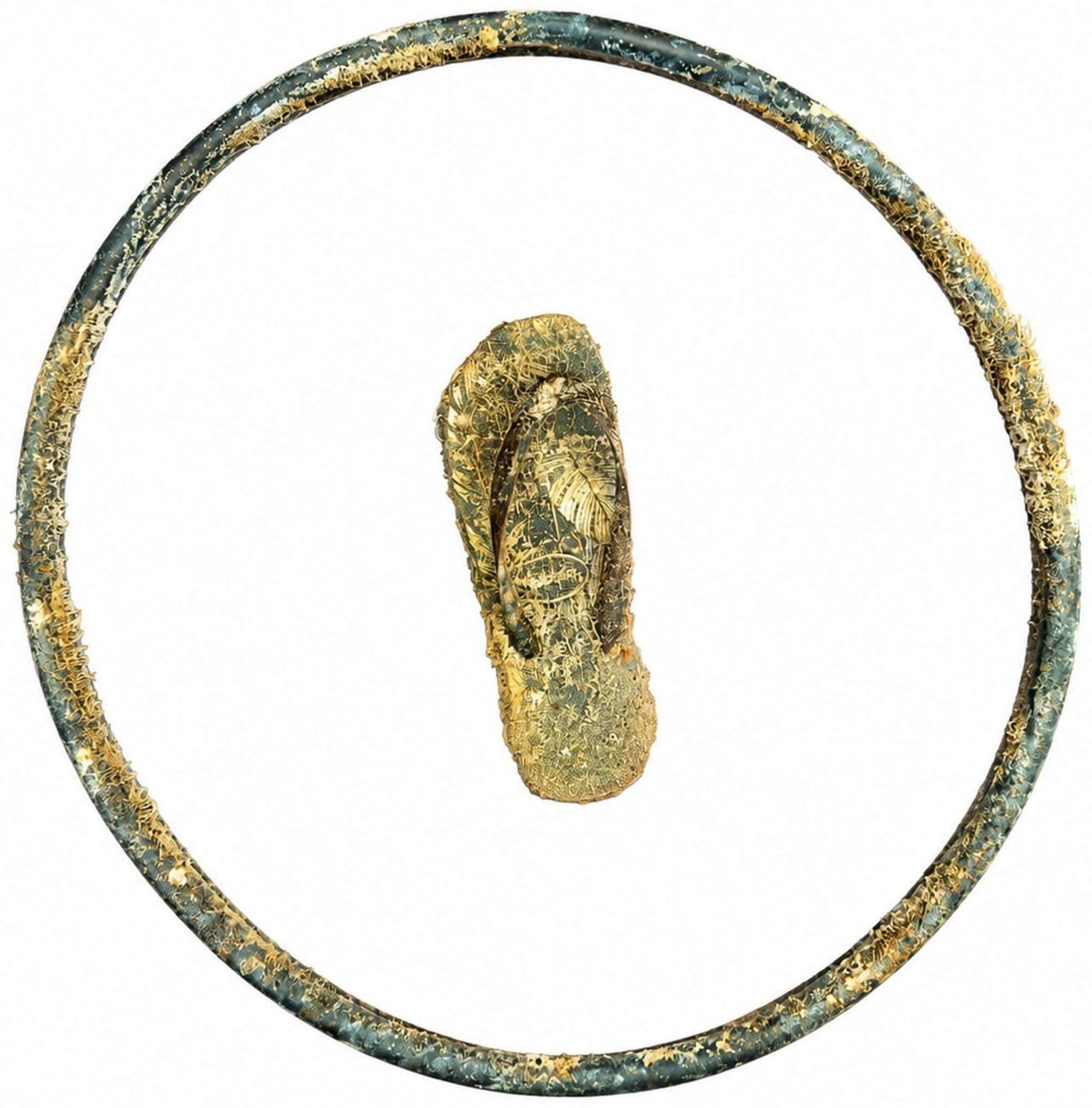
By treating a popular Brazilian flip-flop as an archaeological relic pulled from the seabed, the artist turns a mass-consumption product into a historical artefact. He thus repurposes a familiar symbol to give it an almost sacred dimension.

Playing on balance and emptiness, the work becomes a meditation on the human trace and the passing of time.

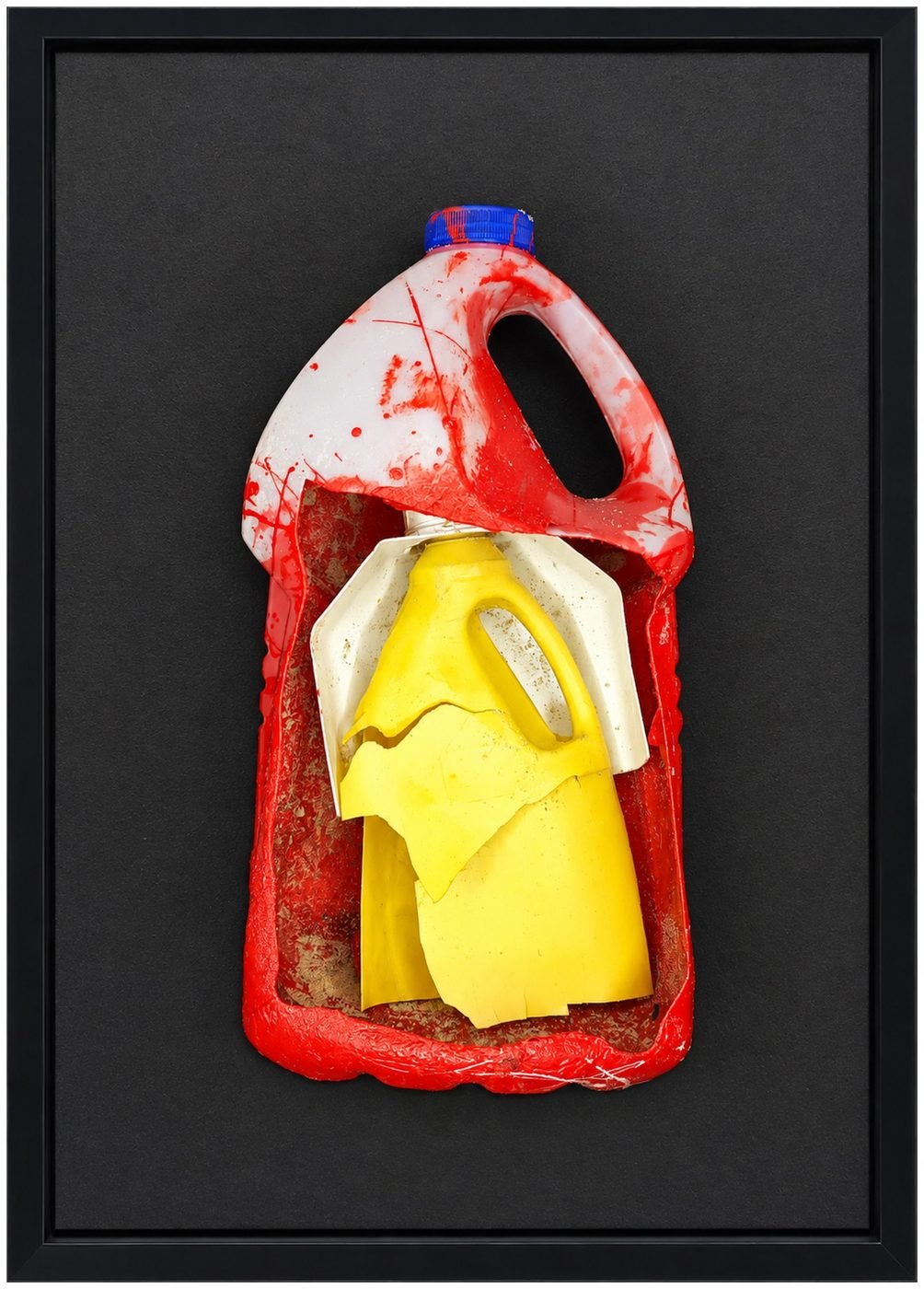
Still Life — Plastics, acrylic paint and sand mixed together — Arnaud Caron (Artno)

Still Life

MaterialsPlastics, acrylic paint and sand mixed together
Dimensions60 × 45 cm

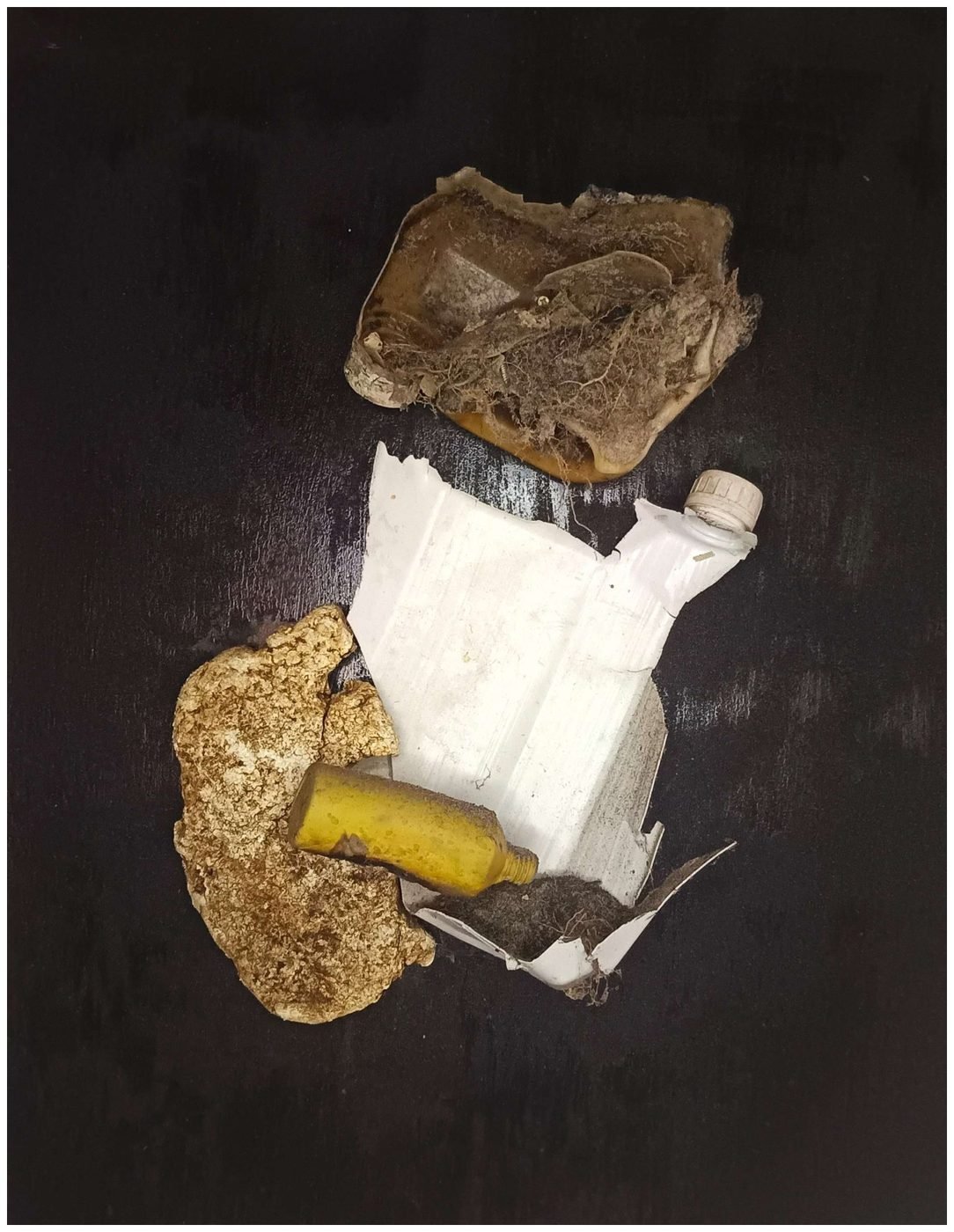
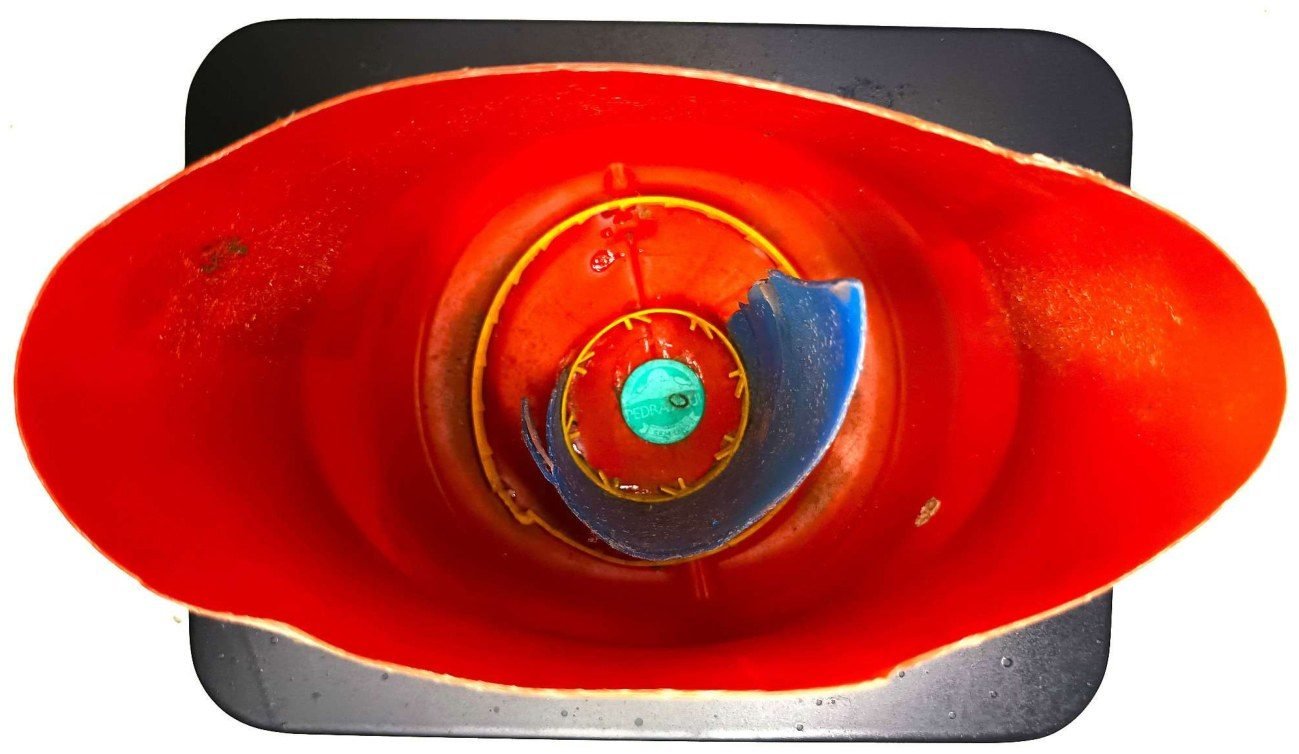
‘Still Life’ subverts one of the oldest genres in the history of art. The objects traditionally depicted are replaced by deformed plastic containers, cut up and nested inside one another. The expression in the title then takes on a literal meaning: what is shown is no longer a representation of nature, but the artificial residue our society leaves it with — a lifeless yet almost indestructible object.

The work ultimately offers a reflection on our consumer society and the lasting imprint it leaves behind. The traditional still life reminded mankind that all life is destined to disappear. Here, the paradox is reversed: nature disappears, while our waste remains.

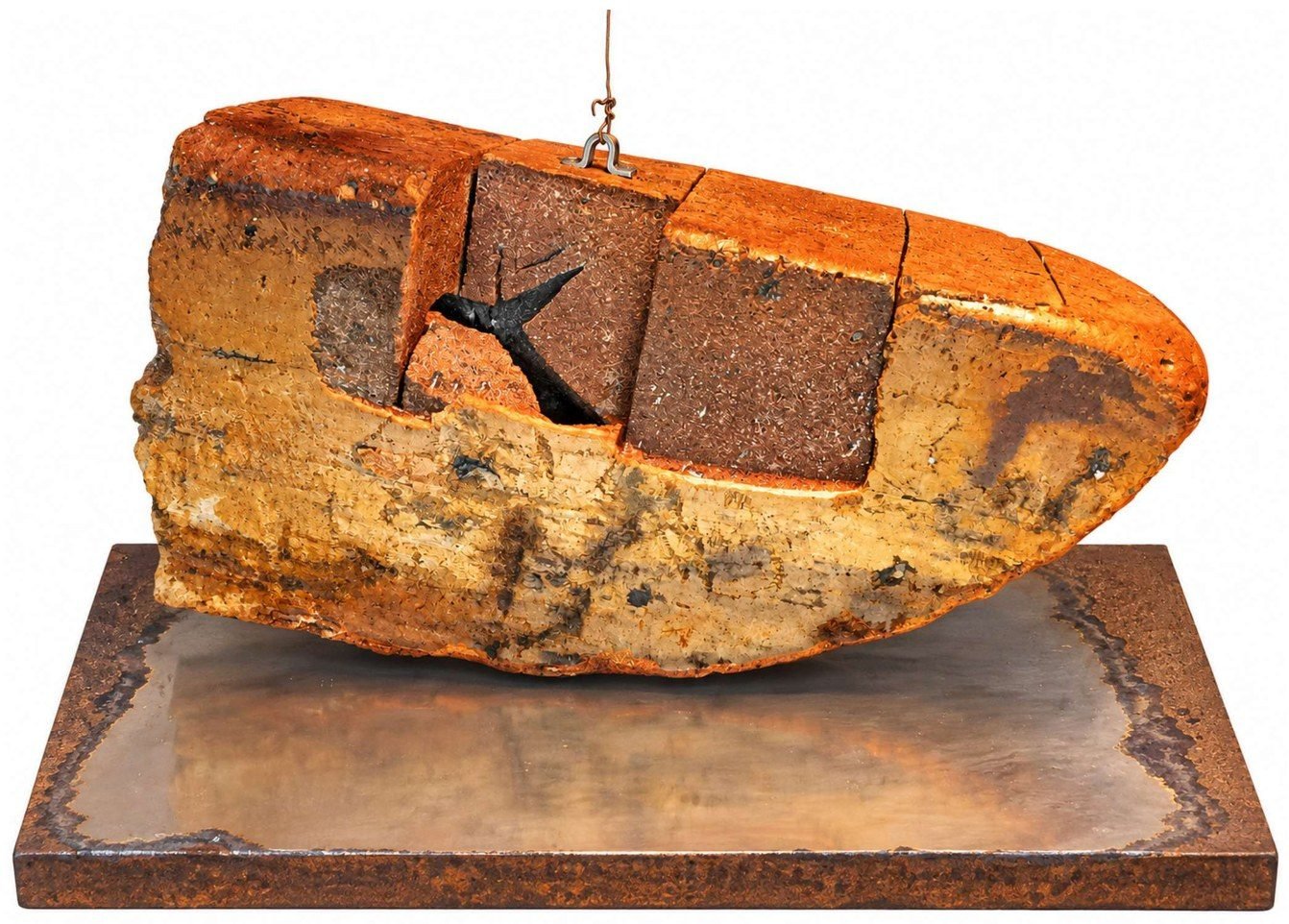
Perpetual — Glass pane, polystyrene, wire, acrylic paint and sand mixed together — Arnaud Caron (Artno)

Perpetual

MaterialsGlass pane, polystyrene, wire, acrylic paint and sand mixed together
Dimensions80 × 80 cm

‘Perpetual’ questions the persistence of the waste produced by mankind and its confrontation with nature’s ceaseless motion. The block of polystyrene, found on a beach, becomes witness to a pollution left to the elements.

Conceived as a mobile, the work introduces an essential dimension: movement. Suspended and subject to air currents, the fragment oscillates continuously. This perpetual motion evokes that of the sea, of waves and tides that ceaselessly carry waste before depositing it on the shore.

Carried by movement yet condemned to persist, this fragment becomes the symbol of a pollution that endlessly continues its journey.

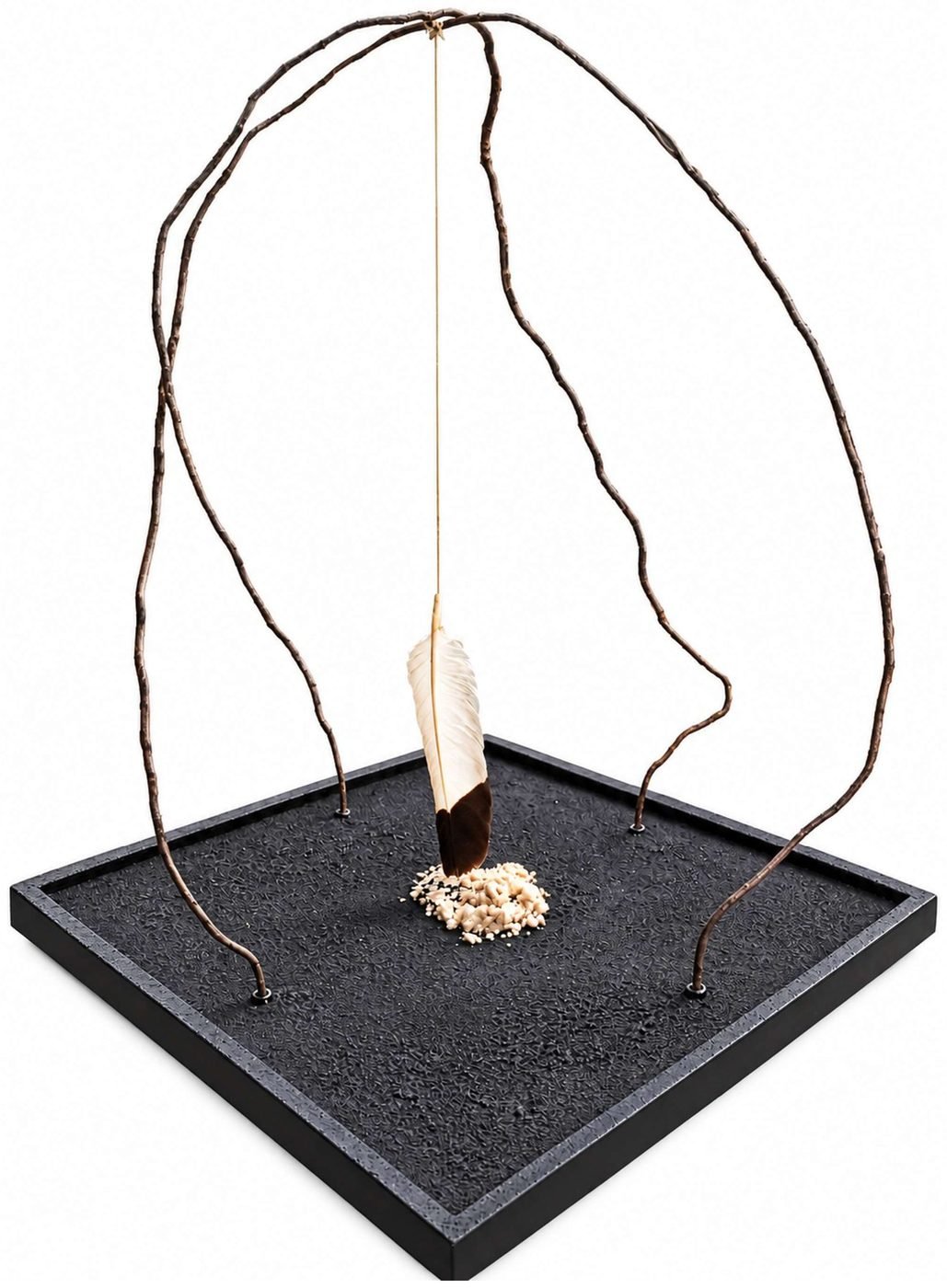
The Cage — Wire, feather, sand, acrylic paint — Arnaud Caron (Artno)

The Cage

MaterialsWire, feather, sand, acrylic paint
Dimensions30 × 30 × 50 cm

The work introduces a tension between confinement and freedom. Yet the cage is not closed: it appears permeable, vulnerable, as if the confinement it symbolises were more mental or existential than material. An ambiguity then appears: the cage protects as much as it imprisons. It offers security and sustenance, but in exchange for a renunciation of outside space. The work thus questions the cages we build for ourselves: habits, fears, comfort, dependencies or social constraints.

Contemplating it becomes an invitation to meditation, and perhaps to escaping our own cage.

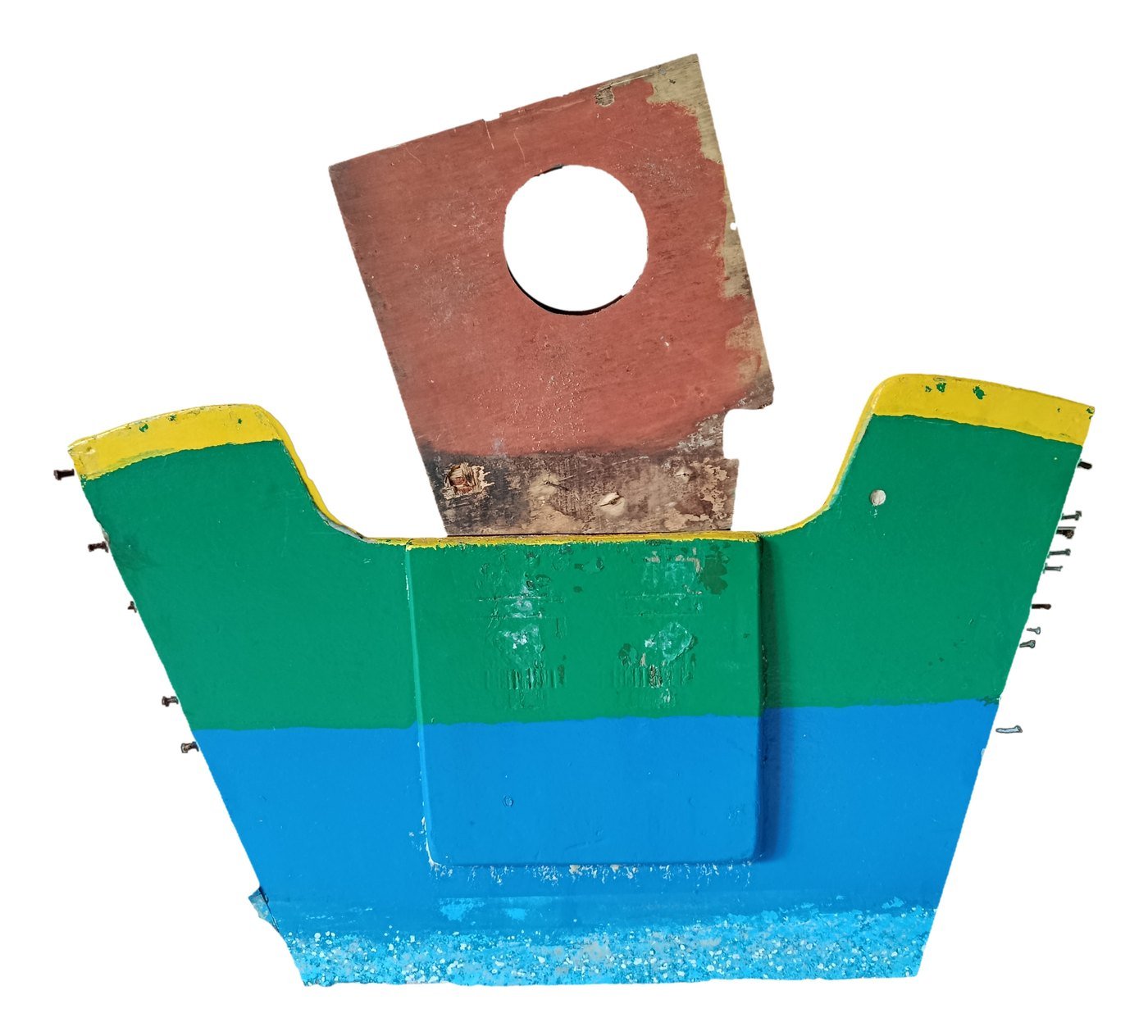
Shipwreck — Wood and nails — Arnaud Caron (Artno)

Shipwreck

MaterialsWood and nails
Dimensions100 × 80 cm

Made from the wood of a fisherman’s boat washed up on the beach, Shipwreck is a relic turned sculpture. Its brightly coloured hull, worn by time, keeps the scars of its history.

At the top, a plank pierced by an empty circle stands like an enigmatic presence, an eye without a gaze or an opening onto nothingness. This contrast between the coloured mass and the void gives the work its singularity: the boat seems to have lost the sea, but also its function, its crew and perhaps even its reason for being.

More than an abandoned object, it becomes the metaphor of an existential shipwreck. The stranded wood does not recover its former life; it invents another, in which the traces of disappearance become material for creation.